
BLOGS Stay Near Arulmigu Kailasanathar Temple, Saendha Poomangalam | Nava Kailayam 9th & Final Temple — Sukran (Venus) Sthalam Nava Kailasam Temples May 12, 2026 Sri Kailasanathar Temple The place where the last flower reached came to be known as Sernthapoomangalam which literally translates to “Place where the last flower rested.” This ninth and final temple is dedicated to Venus Sukran and forms the last of the three temples of the Lower Kailayam (Keezh Kailayam). This is the ninth and last of the Nava Kailasam temples located on the banks of the Thamirabarani River, dedicated to Sukran. The temple was consecrated by Sage Romaharshana. The planetary deity Sukran is believed to rule over a person’s life for 20 years and it is believed that during this time, he blesses the person with fame, fortune, and wealth. Sukran worshipped Shiva at this temple, and so Shiva himself imbibes all the qualities of Sukran, in addition to being the Adipathi of all the Navagrahas. Worshipping Lord Shiva here is equivalent to worshipping in Agneeswarar Temple at Kanjanoor near Kumbakonam one of the most powerful Sukra Sthalam temples in all of Tamil Nadu. This is no ordinary final stop Saendha Poomangalam is where the sacred Thamirabarani River completes its divine journey and merges with the sea at Punnakayal (Sangumugam) making this the most spiritually complete and poetic conclusion to the entire Nava Kailayam pilgrimage. For pilgrims completing this sacred circuit, Ananta Vihara in Thirukolur is the most peaceful and conveniently located homestay base. The Lord of this temple is Sri Kailasanathar and the Goddess is Sri Soundarya Nayagi. Lord Shiva takes on the features of Venus Sukran here. The temple faces east, with an entrance from the south the east side entrance is kept closed. Balipeedam, Dwajasthambam, and Rishabam are after the east side entrance. The Moolavar is on a round Avudayar. Dwarapalakas, Vinayagar, and Murugan are at the entrance of the sanctum sanctorum. A Rishabam is also in the Ardha Mandapam facing the sanctum sanctorum. This temple has Nava Lingas in place of the Navagraha sannathi a completely unique and rare feature found nowhere else in the entire Nava Kailayam circuit. While other temples have separate Navagraha idol shrines, here the nine planets are represented as nine sacred Shiva Lingams making every prayer here a direct Shiva worship for each planetary deity. Subsidiary Deities Shrines in this temple include Kanni Vinayagar, Chokkanathar, Bhairava, Meenakshi, planets Sun, Moon, and Sani Bhagwan. Lord Muruga is on his peacock vahana. Other shrines include Navagrahas (as Nava Lingams), Saptamatrikas, the Nayanmars, and Kubera on the Ambal Vimana. Why “Saendha Poomangalam”? The name of the village Sernda-poo-mangalam literally means “the place where the flowers were finally collected.” Here the Lord is considered to represent Shukran or Venus. This is the last and ninth flower given by Sage Agasthya that washed up at this sacred bank of the Thamirabarani. The Legend Agasthiyar’s Sacred Mission During the celestial wedding of Shiva and Parvati, all the Devas, Rishis, and Munis assembled at Mount Kailash to witness the marriage. Due to this massive gathering, the earth’s north side went down in level and the south rose up equally. Shiva asked Agasthiyar to go to the South to balance it. On his way to Podhigai, Agasthiyar installed and worshipped Shiva Lingams at many places. It is believed that the Moolavar of this temple was also installed and worshipped by Agasthyar. As per another legend, Agasthiyar’s first disciple Uroma Maharishi and the Kings of the Seas attained Mukti liberation at this very place. This makes Saendha Poomangalam not just the geographical end of the Nava Kailayam circuit but also its spiritual summit the place of ultimate liberation. The Sacred Geography — Where the River Meets the Sea The river Thamirabarani flows at a distance of half a kilometre from the temple at Sernthapoomangalam, and a sacred bathing Ghat is present here. Due to the rapid flow of the water, the river confluences with the sea at Punnakayal which is around four kilometres from here. This place is known as Sangumugam. This Sri Kailasanathar temple is located where the Thamirabarani River confluences with the sea the Palk Strait. It is believed that those who take a dip in the Chandikan Teertham and worship Shiva here will get the Sukra Yoga the most auspicious planetary blessing of Venus. The confluence of the Thamirabarani with the sea at Punnakayal (Sangumugam) is considered a sacred Triveni making a bath here one of the most spiritually powerful acts in the entire Nava Kailayam pilgrimage! Sukran’s Own Penance — The Legend Sukran worshipped Shiva at this temple making this the Sukra Parihara Sthalam where the planet Venus himself sought and received the blessings of Lord Shiva. Since Sukran directly worshipped here, the Lord imbibes all the qualities of Sukran in addition to being the Adipathi the supreme Lord of all nine Navagrahas. This makes Saendha Poomangalam one of the rarest temples in Tamil Nadu where the planetary deity himself is the prime devotee and the Lord has absorbed that planet’s essence into himself! Unique Feature Nava Lingas Instead of Navagraha Idols This temple has Nava Lingas in place of Navagraha sannathi nine Shiva Lingams representing the nine planetary deities. This is a completely unique feature not found in any other Nava Kailayam temple, and symbolizes that at Saendha Poomangalam, all nine planetary forces are unified in Lord Shiva himself making a single visit here equivalent to worshipping all nine Navagrahas. Navagraha Significance Sukran (Venus) Sthalam The planetary deity Sukran is believed to rule over a person’s life for 20 years the longest ruling period of any Navagraha. During this time, he blesses the person with fame, fortune, and wealth. Worshipping here is equivalent to worshipping at the Agneeswarar Temple at Kanjanoor near Kumbakonam one of the most powerful Sukra Sthalam temples in all of Tamil Nadu. This temple is the Parihara Sthalam for doshas related to Sukran Venus and worshipping Lord Kubera here specifically increases family wealth. Devotees pray

Stay Near Sri Kailasanathar Temple, Rajapathy | Nava Kailayam 8th Temple | Ketu Sthalam
BLOGS Stay Near Sri Kailasanathar Temple, Rajapathy | Nava Kailayam 8th Temple | Ketu Sthalam Nava Kailasam Temples May 11, 2026 Sri Kailasanathar Temple Uromasa Maharishi worshipped the place of rest of the eighth flower as Ketu Thalam at Rajapathy the eighth among the nine Nava Kailayam temples on the banks of the sacred Thamirabarani River. This is the spot where Ketu was devoted to Lord Shiva Kailasanathar hence praised as the Kethu Parihara Sthalam. The primary puja for the sanctification of Rajapathi Kailasanathar temple started on the very day when the Raja Gopuram of the Kalahasthi temple was damaged. Subsequently, this spot and temple is viewed as Then Kalahasti the Kalahasthi of the South. There are only two temples for Ketu in Tamil Nadu one is at Keelaperumpallam in Nagapattinam district and the other is at Rajapathy on the banks of Thamirabarani. This makes Rajapathy one of the rarest and most powerful Ketu Parihara Sthalams in all of Tamil Nadu and an absolutely essential stop for all pilgrims on the Nava Kailayam Yatra. For devotees making this sacred journey, Ananta Vihara in Thirukolur is the most peaceful and conveniently located homestay base. The Moolavar is Arulmigu Kailasanathar and the Ambal is Arulmigu Soundaranayaki meaning “the Goddess of Supreme Beauty.” As per scriptures, Ketu himself prayed to Lord Shiva at this sthalam hence it holds extraordinary power for all who suffer under the influence of the shadow planet Ketu. Lord Shiva represents the wisdom character attributed to the serpent planet Ketu at Rajapathy. The Nandi is located facing the main Shiva Lingam. Subsidiary deities include Ganesha, Subramanian, Navagrahas, Bhairava, and Nataraja. In ancient times, kings prayed at this temple to win wars and battles hence this temple is a favourite among politicians, bureaucrats, and leaders seeking victory and success in their endeavours. Budhan is the planetary deity associated with the mind and intellect. Budhan is also the planet associated with rains just like Varuna is the god of rains and water. Both Budhan and Varuna worshipped here, and so this place is also called Varuna Kshetram. The seventh flower of Sage Romasa stopped at Thenthiruperai and the temple here was dedicated to Mercury God. This temple is the first among the three temples of the Lower Kailasam (Keezh Kailayam). This sacred temple is also doubly blessed the seventh Nava Tirupati temple Makara Nedunkuzhaikathar Perumal Temple is also present at this place. Making Thenthiruperai one of only two towns in the entire region where both the Nava Kailayam and Nava Tirupati pilgrimages converge! For pilgrims on the Nava Kailayam Yatra, Ananta Vihara in Thirukolur is the most peaceful and conveniently located homestay base. This seventh Nava Kailayam temple is also known as Ponnammai Sametha Kailasanathar Temple. Shiva is worshipped here as Kailasanathar. Mother Goddess Shakti is worshipped as Alakiya Ponnammai. Nandi murti is found facing the main Shiva Lingam. The subsidiary deities worshipped here include Navagrahas, Bhairava, Ganesha, and Muruga with his consort Valli. In this temple, Lord Shiva graces as a Swayambu Murthy a self-manifested Shiva Lingam for devotees and pilgrims. The base of the Lingam is uniquely shaped like a lotus flower a beautiful divine symbol representing purity and spiritual elevation. The Agamam followed here is Kameeyam and the sacred tree is the Vilwa. In the Navagraha shrine, Guru and Sukran are seen riding horses instead of their usual mounts. Suryan is depicted riding his usual 7 horses but Chandran is uniquely shown with 10 horses. This rare sculptural depiction is found nowhere else in the entire Nava Kailayam circuit. In this temple, Lord Muruga looks like Sri Shanmuganathar of Thiruchendur with Valli and Devasena. Sri Vallabha Ganapathi, Sri Sakthi Ganapathi, Sri Kannimoola Ganapathi, and Sri Siddhi Vinayaga arrive in isolated sanctums in this temple. The Meaning Why “Rajapathy”? The name of the place itself comes from the fact that this place used to be the residence of the Pandya king in times of yore Raja refers to the king, and Pathy/Pathi refers to the place. Hence Rajapathy means “the Royal Abode” a town of kings. The spot is named after the royal residence of a Pandya lord belonging to the Chandra tradition making this an ancient and historically significant kshetram with deep royal heritage. A Temple Rebuilt by Devotion The Modern Miracle This is the only Kailasam among all the Nava Kailayam temples that did not have a temple premises until the year 2008. There was only a stone pillar that remained from the ancient Shiva temple constructed by Uromasa Maharishi. However, steadfast devotees were not discouraged by the lack of a regular temple. They believed that the aura of the Lord still prevailed in the region and worshipped him here. A few others who lacked belief moved to worshipping the Lord at a ruined temple at Kutti Thottam on the main road to Tiruchendur next to Thenthiruperai. However the construction of a magnificent new temple at Rajapathy has created innate happiness among devotees a testimony to the rule and might of Ketu. Miracles occurred to those who helped in the temple construction. Devotees bought a land of around 1.5 acres in the area where the original temple is believed to have existed. The temple works were carried out under the supervision of the Kailash Trust of Kovilpatti. The construction was completed and the first Kumbabhishekam was done in the year 2010. The Ancient Temple Destroyed by Floods The ancient temple that was destroyed by floodwaters was originally constructed by the Madurai Chandra Kula Pandya kings. After the flood, different elements of that temple were taken to different places. The Nandi of this temple is now believed to be at Ottapidaram and it is a common belief among the people that their cattle remain free of diseases when special abhishekams are performed for this Nandi. The pillars and idols were washed away to Puraiyoor, Marukaal, Vaikal Karai, Thenthiruperai, and Ottapidaram by devotees. Ketu’s Own Penance The Legend As per scriptures, Ketu himself prayed to Lord Shiva at

Stay Near Sri Kailasanathar Temple, Thenthiruperai | Nava Kailayam 7th Temple | Budha (Mercury) Sthalam
BLOGS Stay Near Sri Kailasanathar Temple, Thenthiruperai | Nava Kailayam 7th Temple — Budha (Mercury) Sthalam Nava Kailasam Temples May 9, 2026 Sri Kailasanathar Temple Lord Shiva takes the form of Budhan at the seventh Kailasam at Thenthiruperai on the banks of Thamirabarani. One can attain command over speech, intellect, and the ability to make others listen to one’s words with the blessings of the Lord at this temple. Budhan is the planetary deity associated with the mind and intellect. Budhan is also the planet associated with rains just like Varuna is the god of rains and water. Both Budhan and Varuna worshipped here, and so this place is also called Varuna Kshetram. The seventh flower of Sage Romasa stopped at Thenthiruperai and the temple here was dedicated to Mercury God. This temple is the first among the three temples of the Lower Kailasam (Keezh Kailayam). This sacred temple is also doubly blessed the seventh Nava Tirupati temple Makara Nedunkuzhaikathar Perumal Temple is also present at this place. Making Thenthiruperai one of only two towns in the entire region where both the Nava Kailayam and Nava Tirupati pilgrimages converge! For pilgrims on the Nava Kailayam Yatra, Ananta Vihara in Thirukolur is the most peaceful and conveniently located homestay base. This seventh Nava Kailayam temple is also known as Ponnammai Sametha Kailasanathar Temple. Shiva is worshipped here as Kailasanathar. Mother Goddess Shakti is worshipped as Alakiya Ponnammai. Nandi murti is found facing the main Shiva Lingam. The subsidiary deities worshipped here include Navagrahas, Bhairava, Ganesha, and Muruga with his consort Valli. In this temple, Lord Shiva graces as a Swayambu Murthy a self-manifested Shiva Lingam for devotees and pilgrims. The base of the Lingam is uniquely shaped like a lotus flower a beautiful divine symbol representing purity and spiritual elevation. The Agamam followed here is Kameeyam and the sacred tree is the Vilwa. In the Navagraha shrine, Guru and Sukran are seen riding horses instead of their usual mounts. Suryan is depicted riding his usual 7 horses but Chandran is uniquely shown with 10 horses. This rare sculptural depiction is found nowhere else in the entire Nava Kailayam circuit. In this temple, Lord Muruga looks like Sri Shanmuganathar of Thiruchendur with Valli and Devasena. Sri Vallabha Ganapathi, Sri Sakthi Ganapathi, Sri Kannimoola Ganapathi, and Sri Siddhi Vinayaga arrive in isolated sanctums in this temple. The Meaning Why “Thenthiruperai”? The word “perai” refers to a fort. There is a place called Tirupperai near Trichy, which used to be a key location during Chola times. This place must have also had a fort at some time in the past — and to differentiate it from the other town of the same name in the north, this place came to be called Then (southern) Tirupperai — Thenthiruperai. Another legend states that since Goddess Bhoomadevi performed penance here with the Sri Perai form of Lakshmi, it acquired the name Thiruperai. Stone inscriptions on the temple walls dating to the era of Maravarman Sundara Pandian the First also mention this place as “Sundarapandia Chathur Vethi Mangalam.” The Legend of Varuna & Sukra — The Varuna Kshetram Since the Lord of rain Varunan and the planet for rain Sukran performed penance here, this place is known as Varuna Kshetram the sacred abode of the Rain God. This makes Thenthiruperai a place of extraordinary power for devotees seeking relief from drought, water-related difficulties, and Varuna’s blessings for agriculture and prosperity. The Legend of Sage Romaharshana’s Idol A murti of Sage Romaharshana the very sage who consecrated this temple was left here at this temple by an unnamed devotee. Today, devotees are directly allowed to perform puja to this murti by themselves a rare and deeply personal spiritual offering not found in most Tamil Nadu temples. The Miracle of the Horned Coconut 🥥 During colonial times, a visiting British army officer asked for coconut water to drink. The farmer refused, since the practice was to offer the coconuts only to the temple. The enraged officer thundered and asked if the coconut was so special that it had grown horns. When the frightened locals eventually gave him the coconut, he found that it had indeed sprouted two horn-like extensions bewildering the officer completely! That particular coconut with horns is kept in the temple even today in front of the Amman sanctum as a living testament to the divine power of Lord Kailasanathar at Thenthiruperai. The TVS Family Connection Both the Kailasanathar Shiva Temple and the Makara Nedunkuzhaikathar Vishnu Temple at Thenthiruperai are being supported significantly by members of the TVS family one of India’s most prominent business families who hail from nearby Tirukurungudi. Equivalent of Thiruvenkaadu — A Sacred Comparison Worshipping the Lord at this temple is as beneficial as praying at Thiruvenkaadu near Seerkazhi one of the most powerful Budha Sthalam temples in Tamil Nadu. This sacred equivalence means that pilgrims who cannot travel to Seerkazhi in Nagapattinam district can receive the complete blessings of Budha by worshipping here at Thenthiruperai saving time and distance while receiving equal spiritual merit. Navagraha Significance — Budha (Mercury) Sthalam According to Hindu beliefs it is said that only the influence of Mercury determines one’s intelligence. Success is determined only by the presence of mind and intellect. This temple is beneficial for people of the sun signs Gemini (Mithunam) and Virgo (Kanni). Those who want to get the goodwill of planet Mercury should offer green clothes, green gram, and sugar to planet Budha and worship. People visit the temple and pray here for education, for the fulfillment of wishes, and for prosperity. Devotees pray here for: Relief from Budha (Mercury) dosha Intelligence, speech, and communication skills Academic excellence and educational success Business acumen and commercial success Gemini (Mithunam) & Virgo (Kanni) Rasi blessings Rainfall and agricultural prosperity Fulfillment of wishes and desires Family prosperity through Perumal darshan nearby Special Days: Wednesday (Budhan Kilamai) and Pradosham prayers are most powerful here. Special Offering: Green clothes, green gram (pachai payaru), and sugar to Budha
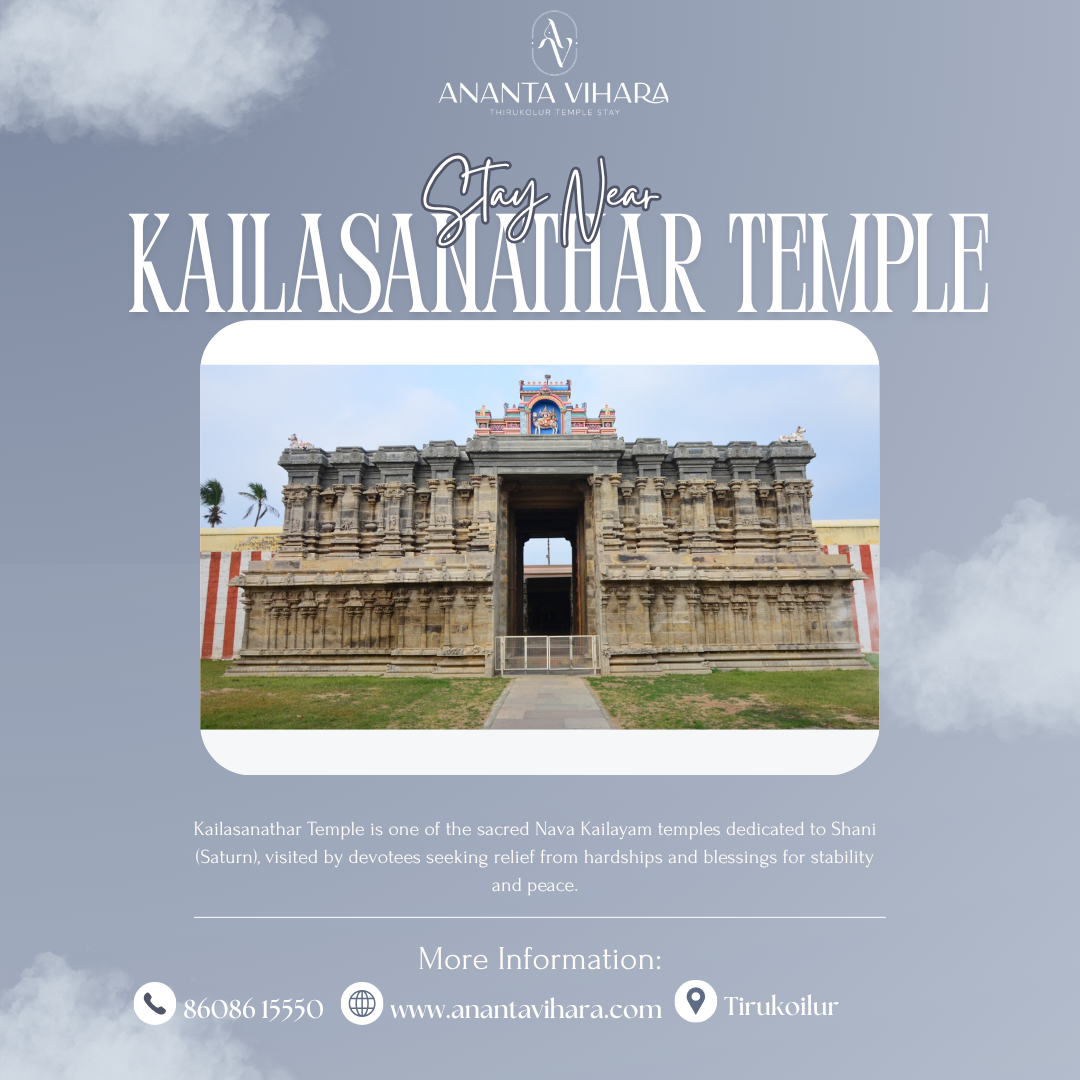
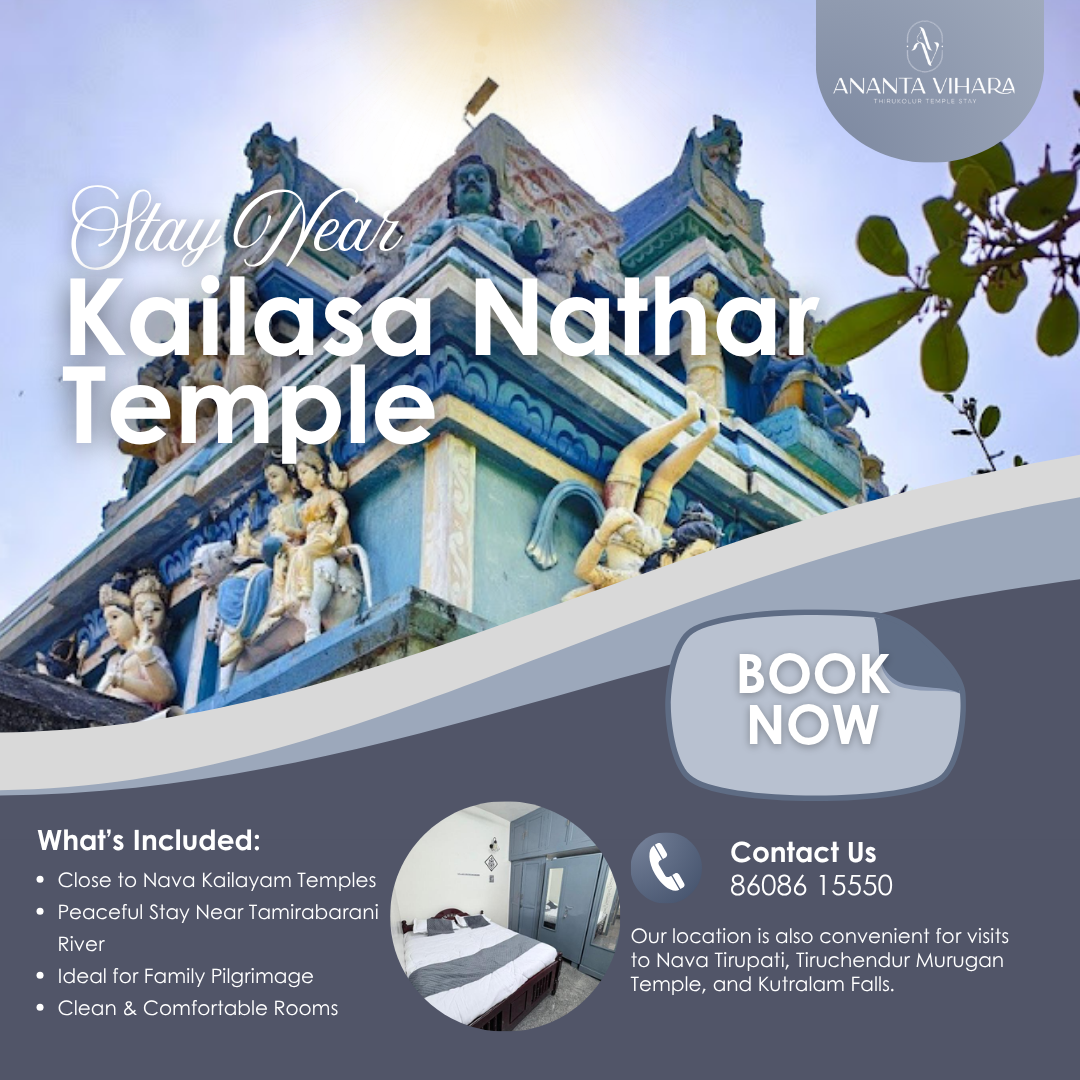
Stay Near Sri Kailasanathar Temple, Srivaikuntam | Nava Kailayam 6th Temple | Shani (Saturn) Sthalam
BLOGS Stay Near Sri Kailasanathar Temple, Srivaikuntam | Nava Kailayam 6th Temple Shani (Saturn) Sthalam Nava Kailasam Temples May 8, 2026 Sri Kailasanathar Temple The sixth Kailasam temple at Srivaikuntam was built by Uromasa Maharishi the grandson of Lord Brahma and the devoted disciple of Sage Agasthiyar. This is the Sani Sthalam among the Nava Kailayam temples, and it holds extraordinary power for devotees suffering under the influence of Saturn. The village of Srivaikuntam is unique in the sense that it is one of the Nava Kailayam temples of Saivites AND one of the Nava Tirupati temples of Vaishnavites making it the only place in Tamil Nadu where both the Nava Kailayam and Nava Tirupati pilgrimages converge in the same sacred town. It is a firm belief among devotees that worshipping here is equal to worshipping at the famous Thirunallaru Sani Bhagawan temple one of the most powerful Saturn temples in all of Tamil Nadu. For pilgrims on the Nava Kailayam Yatra, Ananta Vihara in Thirukolur just minutes from Srivaikuntam is the most peaceful and perfectly placed homestay base. The Moolavar is Arulmigu Kailasanathar and the Ambal is Arulmigu Sivagami Amman. The Theertham is the sacred Thamiraparani River. The Thala Vruksham (sacred tree) is the Iluppai tree. The temple follows Karana Agamam tradition. The Lord is in Swayambu Lingam form a self-manifested Shiva Lingam. Among all nine Nava Kailayam temples, Swayambu Lingams are found only at Papanasam and Srivaikuntam making this one of the two most sacred and powerful shrines in the entire circuit. The Nataraja in this temple is called Santhana Sababathi meaning the Nataraja anointed with sandalwood. The flagstaff of the temple is believed to have been brought all the way from Devi Kanyakumari in Kanyakumari district a rare and sacred origin for a temple’s dhwajasthambam. A guardian deity named Bhoothanathar is one of the major shrines in the temple. The image of Bhoothanathar is made of wood and is given the primary role during the Chittirai Brahmotsavam festival a unique wooden deity rarely seen in South Indian temples. The Origin Sixth Flower of Sage Romasa As per legend, Sage Urosamar floated a set of flowers in the Thamirabarani River the sixth flower reached the shore at this place in Srivaikuntam. The sage established a temple for Kailasanathar. The Lingam the aniconic form of Shiva in the temple is believed to be an aspect of Shani, one of the planetary deities. Architecture A Temple Built Like Madurai Meenakshi The temple was constructed in the Dravidian style of architecture. A granite wall surrounds the temple, enclosing all its shrines across three precincts. Shiva is worshipped as Kailasanathar and his consort Parvati as Sivakami. The temple has a flat gateway tower, unlike other South Indian temples that have a pyramidal entrance tower a distinctive and rare architectural feature in the Dravidian temple tradition. The architecture of this temple resembles that of the famous Meenakshi Temple at Madurai. The Nataraja idol here is a masterpiece of South Indian sculptural art. The Power of Shani — Why This Temple Matters According to Hindu beliefs, the period of Ashtamathil Sani and Ezharai Naatu Sani are times of great trials and misery for devotees. This is the reason why people get extremely scared when their zodiac signs are aligned directly under the influence of Saturn God. He rules over a person’s life for nineteen years and determines the extent of internal peace. It is believed that Saturn exerts his influence either as a peaceful breeze or a destructive tornado and his dominant power can turn a person into a prosperous millionaire or a penniless pauper. Those who are affected by Sani dosha pray to Sri Kailasanathar and Sri Sani here to get the curse relieved. The Sri Sani Bhagawan Sannidhi is situated separately inside the temple a dedicated shrine solely for Saturn worship, rare in Tamil Nadu temples. The Only Place Where Both Pilgrimages Meet! A Nava Tirupati temple is located close to this Nava Kailayam temple the sacred Sri Srivaikuntanathan Perumal Temple, which is the first temple of the Nava Tirupati circuit. This makes Srivaikuntam the most spiritually complete stop in the entire pilgrimage belt of South Tamil Nadu where a devotee can worship both: Lord Shiva as Kailasanathar — the Nava Kailayam Sani Sthalam Lord Vishnu as Srivaikuntanathan — the Nava Tirupati First Temple All in the same town, on the same day! Navagraha Significance — Shani (Saturn) Sthalam Praying at Sri Kailasanathar Temple, Srivaikuntam is considered equal to worshipping at the famous Thirunallaru Sani Bhagawan temple in Karaikal one of the most powerful Shani Sthalam temples in all of Tamil Nadu. Devotees pray here for: Relief from Shani (Saturn) dosha Relief from Ezharai Naatu Sani & Ashtamathil Sani Career, job, and financial stability Protection from delays and setbacks Inner peace and mental strength Blessings for Capricorn (Makara) & Aquarius (Kumbha) Rasi Victory over enemies and legal disputes Special Days: Saturday (Sani Kilamai), Sani Peyarchi, and Pradosham prayers are most powerful here. Temple Open Hours: 6:00 AM – 10:30 AM & 5:30 PM – 8:00 PM Major Festivals The Brahmotsavam festival celebrated during the Tamil months of Chittirai (April–May) and Aippasi (October–November) are the most prominent festivals of the temple. During Brahmotsavam, Bhoothanathar the wooden guardian deity is given the primary role in processions. The Brahmotsavam, Maha Shivaratri, and Thirukalyanam are the most important festivals here. Regular rituals along with Veda Parayanam are meticulously conducted year-round. Other key festivals: Brahmotsavam — Chittirai (April–May) & Aippasi (Oct–Nov) Maha Shivaratri — February–March (Grand celebration) Thirukalyanam — divine wedding ceremony Sani Peyarchi — once in ~2.5 years (Most important here!) Pradosham — twice monthly Saturday Sani special poojas — year-round How to Reach From Distance Route Tirunelveli ~30–31 km Bus / Taxi Thoothukudi ~39 km Bus / Taxi Alwarthirunagari ~4.6 km Bus / Taxi Thirukolur ~5 km Taxi Nearest Railway Station: Srivaikuntam Railway Station (1 km from temple) Bus Route: Regular buses from Tirunelveli, Thoothukudi & Tiruchendur — stop at Srivaikuntam bus stand Best Time

Stay Near Sri Kailasanathar Temple, Murappanadu | Nava Kailayam 5th Temple | Guru (Jupiter) Sthalam
BLOGS Stay Near Sri Kailasanathar Temple, Murappanadu | Nava Kailayam 5th Temple — Guru (Jupiter) Sthalam Nava Kailasam Temples May 7, 2026 Sri Kailasanathar Temple Sri Kailasanathar Temple, Murappanadu is one of the Nava Kailayam temples dedicated to Lord Shiva, located at Murappanadu in Tirunelveli District, Tamil Nadu. This temple is associated with Guru Jupiter or Brihaspati among the Navagrahas and is the fifth among the nine Nava Kailayam temples. The shrine is also known as Nadu Kailasam the Middle Kailasam Temple. The temple is called Nadukailasam and Dhakshina Gangai the Southern Ganga. At Murappanadu, the sacred Thamiraparani River uniquely flows from north to south just like the holy Ganga at Kashi making a bath here equivalent to a bath in the Ganga at Varanasi. It is believed that a person can receive the immense blessings of Guru by visiting this Guru Sthalam at Murappanadu. Worshipping Kailasanathar at this temple gives bountiful benefits. This is the Fifth Kailasam and the first among the temples of the Middle Kailasam the crown jewel of the Nava Kailayam circuit. For pilgrims on the Nava Kailayam Yatra, Ananta Vihara in Thirukolur is the most comfortable and conveniently located homestay base across the entire circuit. The Moolavar is Arulmigu Kailasanathar and the Ambal is Arulmigu Sivagami Amman. The Theertham is the sacred Thamiraparani River. The Thala Vruksham (sacred tree) is the Jack tree. The temple follows Karana Agamam tradition. The Lord’s idol faces east to view directly and bless the devotees who take a holy dip in the waters of the river. Goddess Sivagami Ammai faces south and is present in a separate sanctum she is the pinnacle of patience and the saviour of all those who come to her with trust. Subsidiary deities include Ganesha, Subramanian, Guru, Navagrahas, Nataraja, Dakshinamurthy, and other forms of Shiva and Shakti. The sculpture of Lord Hanuman, Kannappar (one among the sixty-three Nayanmars), an elephant, a peacock, and Gomatha (the sacred cow) performing Shiva pooja is mesmerising and makes the onlooker spellbound. Why “Murappanadu”? — Three Beautiful Legends When Soorapadman was committing atrocities against the Devas, the latter wanted to petition Shiva to help them. So they came to this place and worshipped him with proper honours and procedure. As a result, the place came to be known as Muraippadi Easwaranai Nadi Nindra Oor meaning “the place where Shiva was worshipped appropriately” which became Murappanadu over time. Another legend says that a brave woman of this village chased away a wild tiger using just a Muram a winnow used to remove chaff from grain hence the place came to be called Murappanadu. Yet another story goes that this place was filled with flat stones locally called Murambu and hence the name Murappanadu meaning “the place of Murambu stones. The Legend of the Horse-Faced Princess & Nandi A Chola king of the region had a daughter who was unfortunate to have been born with the face of a horse. The king worshipped Shiva, who appeared in his dream and asked him to bathe in the waters of the Thamirabarani River at Murappanadu because at this point the river flows from north to south, and for that reason it is called the Dakshina Ganga. The king did as he was told, and his daughter was restored with a human face. At Shiva’s divine direction, Nandi took on the horse face to absorb the curse. The king, overcome with gratitude, built this temple. Even today, the Nandi at this temple can be seen with the face of a horse a completely unique and unforgettable feature found nowhere else in Tamil Nadu. The Legend of Lord Rama’s Sacred Footprint It is believed that in the Ramayanam, while Rama was figuring out a way to reach Lanka, he passed by Murappanadu. An impression of his sacred foot is preserved in the temple making this not just a Nava Kailayam Shiva temple, but also a Ramayana pilgrimage site of great significance. Historical Glory — The Vijayanagara Connection During the 15th century, when the Vijayanagara Empire was at the peak of its glory, Vittala Rayan the brother of Rama Rayar and the empire’s representative in Tamil Nadu made this temple his encampment. After worshipping Guru Bhagavan at this temple, he waged war on the King of Travancore who refused to pay taxes and won. This historic event cemented the temple’s fame as a place where Guru’s blessings grant victory and triumph. The Unique Navagraha Ritual — Nine Circumambulations Murappanadu has a unique speciality among all the Nava Kailayam temples. It is believed that if one worships the idol of Dakshinamurthy and Shani Bhagavan by performing nine circumambulations, one can get the blessings of all the nine Navagrahas in a single visit. This makes Murappanadu the most spiritually efficient Nava Kailayam temple one circumambulation ritual here covers all nine planetary blessings! Anjasel Perumal — Vishnu’s Ten Avatars Once at this temple, a female devotee witnessed the divine spectacle of Lord Vishnu taking the form of his ten avatars at the same time. This scene is found on a stone inscription here. This temple is known as Sri Anjchel Perumal Temple and the Lord blesses his devotees with wealth. The Dasavatara Kattam (Ten Avatars Panel) at the Thamirabarani River demonstrates this manifestation of the Lord. Navagraha Significance — Guru (Jupiter) Sthalam Among all the nine planets, Guru (Jupiter) occupies a position of prominence hence it is said that if Guru is in a favourable position, one is blessed with immense good fortunes (குருபார்க்க கோடி புண்ணியம்). It is believed that worshipping the Lord at this temple is equivalent to worshipping Lord Shiva at Alangudi one of the most powerful Guru Sthalam temples in Tamil Nadu. This temple is especially beneficial for people born under Sagittarius (Dhanusu) and Pisces (Meenam) Rasi. If women of these sun signs worship the Lord here, they can attain whatever they wish. Devotees pray here for: Relief from Guru (Jupiter) dosha Education, wisdom, and academic excellence Career growth and professional success Financial prosperity and
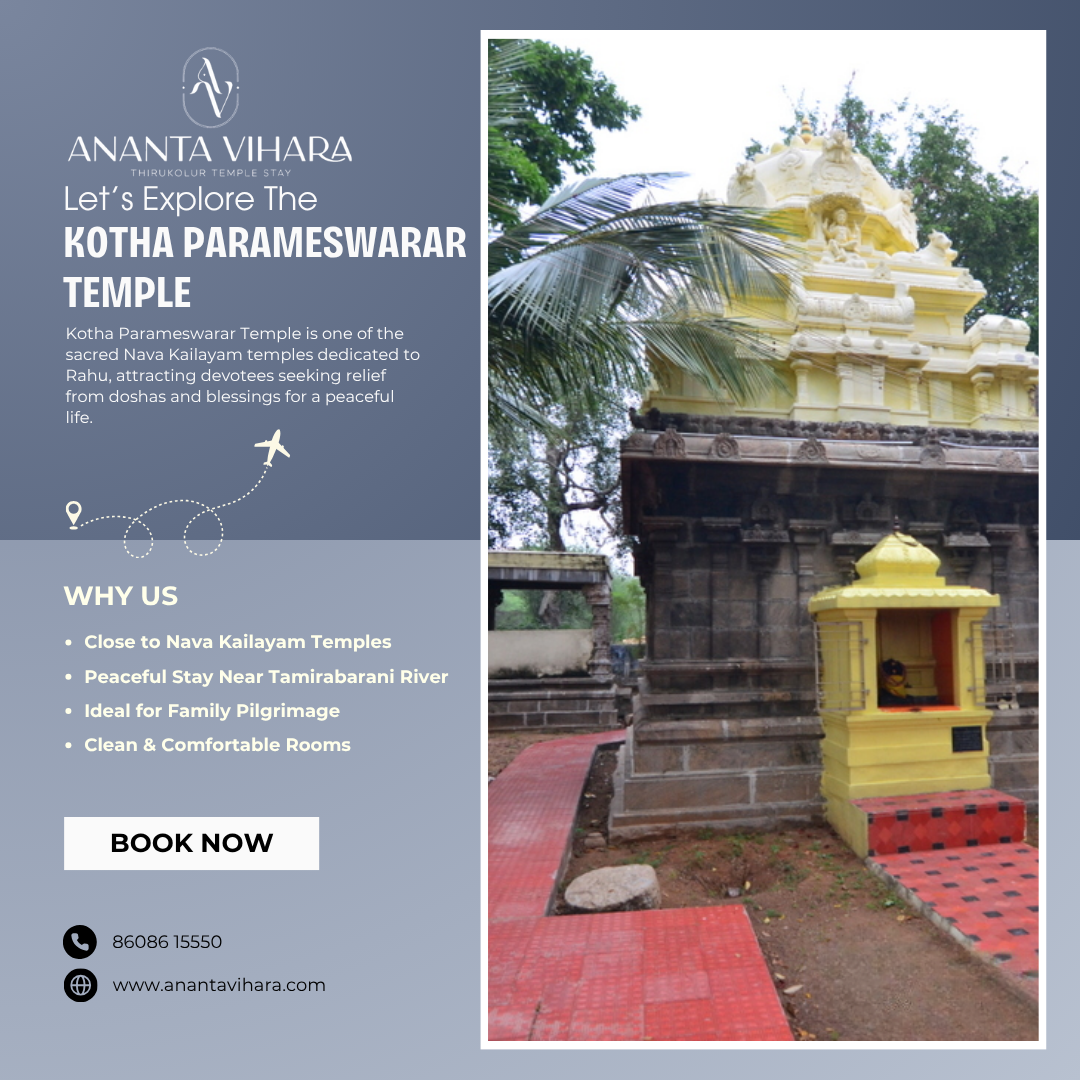
Stay Near Arulmigu Kotha Parameswarar Temple, Kunnathur | Nava Kailayam 4th Temple | Rahu Sthalam
BLOGS Stay Near Sri Kailasanathar Temple, Kodaganallur | Nava Kailayam 3rd Temple — Sevvai (Mars) Sthalam Nava Kailasam Temples May 6, 2026 Sri Kailasanathar Temple Sri Kailasanathar Temple, Kodaganallur, is one of the Nava Kailayam temples dedicated to Lord Shiva, located near Nadukallur village in Tirunelveli district, Tamil Nadu. This temple is associated with Sevvai Mars or Mangal among the Navagrahas, and is the third among the nine Nava Kailayam temples. The third Nava Kailayam temple in Kodaganallur is also known as Kaarkodaga Kshetram and Kodanoor. Since the place was lush with Arjuna trees and fertile green paddy fields, it was a preferred summer destination for royalty and commoners alike hence the name Kodaganallur, literally meaning “the ideal place to spend summer.” This is the Parihara Sthalam for doshas related to Sevvai Angarakan Mars. The Shiva Lingam here is the biggest among all the Nava Kailayam temples. For pilgrims on the Nava Kailayam Yatra, Ananta Vihara in Thirukolur is the most comfortable and conveniently located homestay base across the entire circuit. The presiding deity is Sri Kailasanathar the main altar facing East. The Goddess Sivakami is found in a separate north-facing shrine. The icons of Ganesha and Kartikeya are found at the entrance of the main temple. The sacred tree of this temple is the Wild Puli tree. The temple follows the Shiva Agamam tradition. Subsidiary deities worshipped here include Anantha Gowri Amman, Ganesha, and various forms of Shiva including Nataraja. The temple walls are adorned with paintings of Hindu gods and goddesses and stories from the Puranas. This temple does not have a Kodi Maram (flag mast), Bali Peetam, or Parivara Moorthis making it a simple, intimate, and deeply spiritual shrine. The Legend How Kodaganallur Got Its Name A sage was doing penance in this area, assisted by his devoted son. One day, the son went to the forest to gather firewood. While he was away, a young prince visited the sage seeking spiritual guidance. When the sage remained deep in penance and refused to respond, the angry prince took a dead snake and placed it around the sage’s neck. When the son returned and discovered the act, he cursed the prince, saying that the dead snake would one day come alive and kill the prince’s father the king. Days later, the king consulted his palace priest who revealed he was destined to die from a snake bite. The king then built a special chamber where no snake could enter, and lived there safely. However, the snake took rebirth as a mango worm and on a specific day, the king called for mangoes. The same mango harboured the worm, which killed the king, fulfilling the curse. As the sin was committed by Karkodagan the serpent he decided to perform penance towards Lord Shiva to be relieved of his karma. Lord Shiva came from Kailash to help his devotee and came to be called Kailasanathar here. Since Karkodagan attained Mukti (liberation) at this place, it came to be known as Karkodaga Nallur which over time became Kodaganallur. Unique Features What Makes This Temple Special Daily Nandi Thirukalyanam Generally, the ritual of Thirukalyanam (the divine wedding ceremony) is performed only for female deities. However, in this temple, this sacred ritual is performed daily for Nandi the sacred bull of Lord Shiva. Thousands of devotees gather here to witness this completely unique daily ritual. Mangalsutra Offering to Nandi A unique offering here is making a garland using yellow thread with 58 turmeric pieces and offering it to Nandi in the shrine. This is done in preparation for an early and blessed marriage and the couple should then adorn Nandi with the garland for the wish to be fulfilled. It is estimated that around 16,000 devotees have been blessed with marital bliss by performing this ritual. Hence one can see huge numbers of holy yellow threads the sacred Mangalsutra worn by married women offered to the deity at this temple. Biggest Shiva Lingam in Nava Kailayam The Moolavar is so very large that 8 dhotis measuring 8 muzham (yards) each are used to cover the deity making this the most magnificent Shiva Lingam in the entire Nava Kailayam circuit. Home of Sri Sundara Swamigal Kodaganallur holds special significance as the native town of Sri Sundara Swamigal the Guru of the revered Manonmaniam Sundaranar and the great music scholar Sangeetha Vidwan Subbaiya Bhagavathar. A picture of Sri Sundara Swamigal hangs on the left wall of the Manimandapam in front of the inner sanctum. Only Sringeri Mutt in Tamil Nadu The only Sankara Mutt established in Tamil Nadu by the prestigious Sringeri Mutt of Karnataka is located in this very village of Kodaganallur adding extraordinary spiritual significance to this sacred hamlet. Navagraha Significance Sevvai (Mars) Sthalam Birthplace of Madhurakavi Alvar According to Indian tradition, the Mars God rules over five houses in a person’s horoscope, so his influence dominates one’s life for a period of seven years. It is feared that the life of a spouse is endangered if a horoscope with Sevvai Dosham is matched with one without this Dosham. It is believed that if one worships Goddess Sri Aananda Gowri Ammal at this temple by lighting a lamp every day, one can be relieved from the sufferings caused by Sevvai Dosham. Several devotees have been blessed and freed from their dosham when they offered prayers at this sanctum. This temple is also special for Viruchigam (Scorpio) and Mesha (Aries) Rasi devotees worshipping here is believed to bring positive changes and blessings within two months. Devotees pray here for: Relief from Sevvai (Mars) dosha Removal of marriage delays and obstacles Scorpio (Viruchigam) and Aries (Mesha) Rasi blessings Career, education, and employment blessings Marital harmony and family happiness Relief from snake curses and ancestral karma Liberation (Mukti) for departed souls Special Days: Tuesday (Sevvai Kilamai), Pradosham, and Maha Shivaratri prayers are most powerful here. Architecture This is a small but exquisitely maintained shrine. The temple has only two sanctums and a prakaram. The main

Stay Near Sri Kailasanathar Temple, Kodaganallur | Nava Kailayam 3rd Temple | Sevvai (Mars) Sthalam
BLOGS Stay Near Arulmigu Kotha Parameswarar Temple, Kunnathur | Nava Kailayam 4th Temple — Rahu Sthalam Nava Kailasam Temples May 5, 2026 Kotha Parameswarar Temple, Kotha Parameswarar Temple is dedicated to Lord Shiva and is located at Kunnathur village in Tirunelveli District, Tamil Nadu. The temple is located atop a small hill and Shiva is worshipped here as Kothai Parameswaran. His consort is Goddess Sivakamasundari. This is the fourth among the nine Nava Kailayam temples and is an important place associated with Navagraha Rahu. This fourth Nava Kailayam temple, situated on the banks of the Thamirabarani, is considered the sacred place to worship and get relief from all misfortunes due to Rahu. The Sthala Vriksham is the Vilvam tree and the temple follows the Kamiga Agamam tradition. What makes this temple extraordinary is a breathtaking rareness the Shiva Lingam worshipped here is unique as it has a snake sculpted directly on it this is the only temple where a snake is seen carved into the Lingam itself. For pilgrims on the Nava Kailayam Yatra, Ananta Vihara in Thirukolur is the most peaceful and conveniently located homestay base across the entire circuit. In the east-facing sanctum sanctorum, Swami Kotha Parameswara appears as a Lingam Thirumeni. It is special to see the serpent imprint on the Lingam a divine symbol of Rahu’s sacred presence in this kshetram. The Goddess is worshipped in a separate south-facing shrine with her own separate Vimana. Apart from the main deity and Goddess, the following deities are also worshipped here: Nandi, Dakshinamurthy, Kannimoola Ganapathy, Arumugunainar, Chandikeswarar, Bhairava, and Valli-Deyavan with Murugan making it a beautifully complete Shiva temple despite its modest size. In the outer side of this temple, an Arumuganainar statue is formed in a single stone with Thiruvachi — a rare and remarkable sculptural achievement. A serpent mark is found on the main deity’s Lingam chest. The Meaning — Why “Kunnathur”? Kunnathur is also called Chenkaani — Kaani meaning land and Chenkaani meaning land of red soil. Since it is situated on a small hillock — Kundru in Tamil — it is also known as Kundrathur, which over time became Kunnathur. In ancient times it was called Keelvembunattu Chenkaani alias Navaninarayana Sathurvedhimangalam. The Legend — The Rare Fruit & the Pregnant Woman Once there was a king ruling this area who had a very rare tree near his palace. The tree would flower only once and yield only one fruit — which had the powers of giving eternal youth and strength to whoever consumed it. The king carefully safeguarded the tree, as the fruit was meant for him alone. One day, a pregnant woman was carrying a pot of water from the river and passed by the tree. The ripe fruit fell into her pot without her realizing it. The next day, not finding the fruit, the king ordered a house-to-house search and located the pregnant woman. The woman, frightened, prayed to Lord Shiva — and the Lord appeared to protect her, ultimately blessing the child she carried with divine grace. The king, humbled by the Lord’s intervention, became a devoted Shiva bhakta. This sacred site where the Lord protected an innocent soul from royal wrath became the Kotha Parameswarar kshetram — Kotha meaning the one who protects. The Equivalent of Kalahasti — A Sacred Trinity Kunnathur is one of three temples in close vicinity of each other: the Gotha Parameswarar Temple at Kunnathur, the Varadaraja Perumal Temple at Keela Thiruvengadanathapuram, and the Venkatachalapati Temple at Mela Thiruvengadanathapuram. Together, these three temples are considered the equivalent of Kalahasti, Keezh Tirupati, and Mel Tirupati — and it is customary to visit all three together. It is believed that praying at this group of temples carries the same, if not greater, merit as praying at the corresponding temples at Kalahasti and Tirupati. Furthermore, it is believed that any prayers in the form of venduthal meant for Tirupati can be fulfilled here — but not the reverse. This makes Kunnathur not just a Nava Kailayam stop — but a complete pilgrimage circuit of extraordinary spiritual significance! A Temple Resurrected by Devotion As time passed, this temple began to lose its prominence. A few years ago there were around 100 houses near the temple premises. Due to the unanimous efforts of devoted Shiva devotees of this area, the Lord’s house was slowly resurrected. In those earlier times it was impossible for priests to even enter the sanctum sanctorum to perform poojas, as there were huge serpents lying on the idol of the Lord. Now, poojas are performed regularly at this temple. Historical Significance From the information of this temple’s inscriptions, the temple was built in the 13th century. King Veerapandian donated 4,200 units of money to this temple for daily poojas. There is a land scale in this temple — which, from inscriptions, was used to resolve disputes about land boundaries. From the copper inscriptions preserved at the Nellaiappar Temple in Tirunelveli, this temple was called Thirunaangeesaneri and the deity was called Thirunaagessar — similarly to the famous Thirunaageswaram Rahu Sthalam near Kumbakonam. Navagraha Significance — Rahu Sthalam Worshipping Lord Shiva at this site is considered equal to worshipping at Thirunageswaram near Kumbakonam — one of the most powerful Rahu Sthalam temples in all of Tamil Nadu. Worshipping here rectifies the following problems: stomach problems, mental disorder, haemorrhoids, marital problems, infertility, and academic hardship. This temple is special for Viruchigam (Scorpio) and Mesha (Aries) Rasi devotees. Devotees throng here for relief from Rahu dosham and Naga dosham. Those who do not have children pray here for children. Devotees pray here for: Relief from Rahu dosha Relief from Naga (serpent) dosha Child boon for childless couples Stomach and digestive health Mental peace and clarity Removal of marriage obstacles Academic and career success Scorpio (Viruchigam) & Aries (Mesha) Rasi blessings Special Days: Rahu Kalam prayers on Wednesdays, Pournami (Full Moon), and Pradosham are considered most powerful here. Temple Open Hours: 6:00 AM – 11:00 AM & 5:00
Stay Close to Vaithamanidhi Perumal Temple, Thirukolur | Ananta Vihara | Just 2 Minutes Away!
BLOGS Stay Near Arulmigu Papanasa Nathar Temple, Papanasam | Nava Kailayam 1st Temple — Surya (Sun) Sthalam Nava Kailasam Temples May 4, 2026 Thirupuliyangudi Perumal Temple Vaithamanidhi Perumal Temple, located in the village of Thirukolur in Thoothukudi district, is the eighth temple of the sacred Nava Tirupati circuit dedicated to Lord Vishnu. It is one of the 108 Divya Desams glorified in the Nalayira Divya Prabandham by the Alvar saints, and is associated with the planet Angaraka (Mars) and also known as Kuberasthalam. This is the home temple of Ananta Vihara — our homestay is located just a 2-minute walk from this sacred shrine at 1/42 Mutharamanan Kovil Street, Thirukolur. Pilgrims staying with us can attend early morning prayers, evening aarthi, and all festivals without any travel — truly a once-in-a-lifetime experience for devoted pilgrims. The presiding deity Vaithamanidhi Perumal is in a reclining posture on Adisesha facing East, resting his head on a Marakkal — a wooden measuring vessel meant for measuring wealth. He is looking at the palm of his left hand as if watching over the location of wealth. He is said to hold the Nava Nidhis — the nine forms of divine wealth — under his right shoulder. The festival deity (Urchava Murthy) is hailed as Nishepavithan, who stands in a four-armed posture with Sridevi and Bhudevi. On the Lord’s right is the shrine dedicated to Kolurvalli Thayar (Sridevi) and to his left is Kumudha Valli Thayar (Bhudevi). A granite wall surrounds the temple, enclosing all its shrines. The Rajagopuram, the temple’s gateway tower, is three-tiered in structure. The Vimana above the sanctum is called the Srikara Vimana. The temple’s history traces back to the Chola period, with the oldest inscriptions dating to the reign of Raja Raja I (late 10th–early 11th century CE). The original structure was later refurbished by Rani Mangammal (1689–1704 CE). The Meaning — Why “Vaithamanidhi”? The name Vaithamanidhi means “Possessor of Treasures” — the Lord who safeguarded Kubera’s nine forms of wealth when he was cursed. It is believed that people who pray here are blessed with great wealth and recovery of lost fortunes. The Legend — Kubera & the Nine Forms of Wealth Kubera, the lord of wealth, once cast a lustful glance at Goddess Parvati, the consort of Lord Shiva. An enraged Shiva cursed Kubera to lose the sight in one eye, lose his nine forms of wealth, and roam in a terrible form. The nine forms of wealth of Kubera immediately sought refuge at the feet of Lord Vishnu in Thirukolur on the banks of the Thamirabarani River. Repenting for his sin, Kubera sought the aid of Lord Shiva, who directed him to Goddess Parvati. Parvati then instructed Kubera to go to Thirukolur and perform penance to Lord Vishnu, where his nine forms of wealth had already sought refuge. Kubera performed severe austerities in Thirukolur. Lord Vishnu, pleased with Kubera’s penance, appeared before him and bestowed redemption from the curse, granting a part of the wealth that he had lost. Lord Vishnu in Thirukolur thus came to be hailed as Vaithamanidhi Perumal for safeguarding Kubera’s nine forms of wealth. The Legend of Dharmagupta — Wealth Through Devotion Dharmagupta, a person with eight children who was in utter poverty, sought the refuge of his Guru Bhartbaja, who revealed that in his previous life he had lied to the king regarding his fortune and had not used his wealth righteously. The Guru directed him to go to Thirukolur and worship Vaithamanidhi Perumal. Following his Guru’s instructions, Dharmagupta worshipped here and received the grace of the Lord, who absolved him of his sins and blessed him with wealth — putting an end to his poverty forever. Birthplace of Madhurakavi Alvar Thirukolur is the birthplace of Madhurakavi Alvar — one of the twelve celebrated poet saints of Vaishnavism. Madhurakavi Alvar was an ardent devotee of Nammalvar and his sacred songs are eternally linked to this holy place. The temple has a special shrine dedicated to Madhurakavi Alvar within its precincts — making Thirukolur a town of immense Vaishnava heritage. Navagraha Significance — Sevvai (Mars) Sthalam The temple is associated with the planet Angaraka (Mars / Sevvai) and is known as a Sevvai Dosha Parihara Sthalam — a sacred place for relief from the adverse effects of Mars. Chandra, the Moon God, is also believed to have been relieved of his curse by praying at this temple. Devotees pray here for: Relief from Sevvai (Mars) dosha Recovery of lost wealth and property Removal of financial difficulties Blessings for childless couples Academic excellence for students Success in litigation and legal matters Relief from Kubera dosha & ancestral curses Special Day: Tuesday (Sevvai Kilamai) prayers are considered most powerful here. Architecture Constructed in the Dravidian style of architecture, all the shrines of the temple are located within a rectangular granite structure with two prakarams. The temple has an imposing image of Vishnu in Sayana posture, with a lotus stalk emerging from his navel bearing an image of Brahma. The feet of the deity can be viewed through a special passage. Temple Open Hours: 6:00 AM – 12:00 PM & 5:00 PM – 8:30 PM (Six poojas performed daily) Major Festivals The Avani Festival, held during the Tamil month of Avani (August–September), is a 10-day Brahmotsavam commemorating the avatar day of the deity on Punarvasu Nakshatra. It includes daily morning and evening processions of Vaithamanidhi Perumal on different vehicles, culminating in Garuda Sevai on the fifth night and a grand chariot procession through the four streets surrounding the temple. Vaikuntha Ekadashi, spanning 10 days in the Tamil month of Margazhi (December–January), opens the Vaikuntha Vasal (celestial gate) allowing devotees symbolic entry into Vishnu’s abode. The festival features elaborate processions, recitations of sacred texts, and night-long vigils with special abhishekam of the deity. The Nammalvar Garuda Sevai in Vaikasi (May–June) honors Alvar saint Nammalvar through a unique collective ritual across all Nava Tirupati temples. The festival idols from all nine temples, including Vaithamanidhi Perumal, are
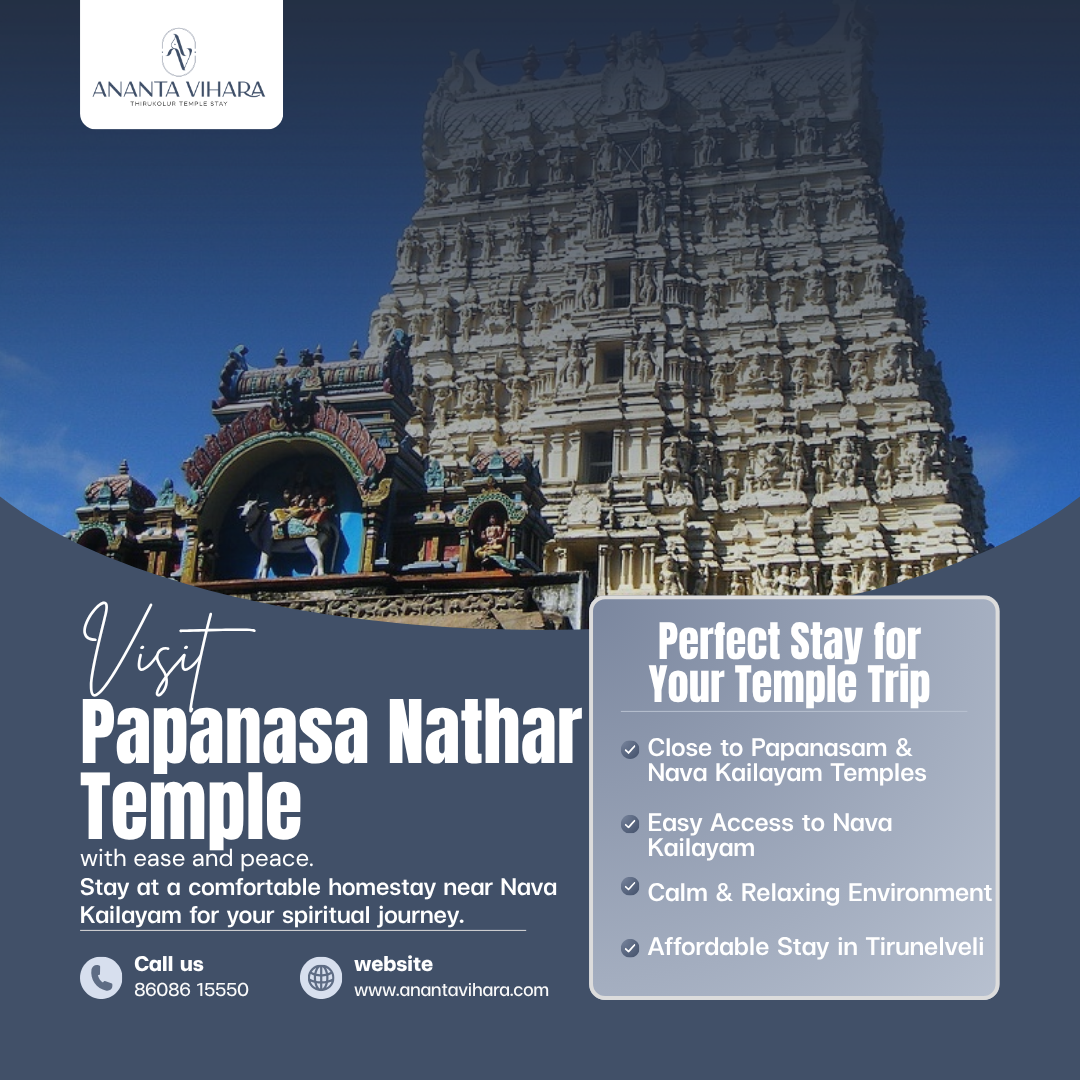
Stay Near Arulmigu Papanasa Nathar Temple, Papanasam | Nava Kailayam 1st Temple — Surya (Sun) Sthalam
BLOGS Stay Near Arulmigu Papanasa Nathar Temple, Papanasam | Nava Kailayam 1st Temple — Surya (Sun) Sthalam Nava Kailasam Temples May 2, 2026 Thirupuliyangudi Perumal Temple Nava Kailayam refers to nine individual ancient temples of Lord Shiva located in the southern districts of Tamil Nadu in Tirunelveli and Thoothukudi districts. All nine temples are linked with Sage Agasthiyar. Sage Agasthiyar placed nine flowers in the Thamirabarani River and instructed his disciple Uromacha Munivar to install a Shiva Lingam as Kailasha Nathar wherever each flower settled on the riverbank and the nine flowers transformed into Shiva Lingams at each sacred location. The first Nava Kailayam temple, built by Uromacha Maharishi, is at Papanasam. Lord Shiva takes the form of the Sun God here. Since the Sun is the first among the nine planets, Papanasam is attributed to the Sun making it the Surya Kailash and Surya Kshetra of the Nava Kailayam circuit. For pilgrims beginning the sacred Nava Kailayam Yatra, Ananta Vihara in Thirukolur is the most convenient and peaceful homestay base ideally located within the Nava Tirupati and Nava Kailayam belts of the Thamirabarani valley. Lord Shiva is worshipped here as Sri Papanasanathar also known as Kailasa Nathar, Pazhama Nayagan, Mukkaleenga Nathar, and Vayirasalinangam. His consort Goddess Parvati is worshipped here as Ulagammai. The Shiva Lingam of this temple is completely made of Rudraksha a rare and extraordinary sacred material. A granite wall surrounds the temple enclosing all its shrines, pierced by a seven-tiered gateway tower. The image of Papanasanathar in the form of a Lingam is housed in the sanctum. There are images of Somaskanda, Rishabaroodar, and Agasthya close to the sanctum with unique sculptural representations. There are two sanctums in the temple one for Papanasa Nathar and the other for Ulagammai. The three courtyards before the inner sanctum are Mada Veethi, Nandavana Sutru, and the Ul-Sutru (Inner Courtyard). The flag mast, Nandi statue, sacrificial altar, and shrines of Bootha Vinayagar and Lord Subramanian are present in the inner courtyard. The statue of Lord Nataraja faces south to enjoy the breeze from the Podhigai Hills. The Origin How Nava Kailayam Was Born Sage Romasa sought the advice of his Guru Agasthya to choose places on the banks of the Thamirabarani River for installing Shivalingas. The teacher told the disciple to throw flowers used for Shiva Puja on the river, and do the installations where the flowers reached the shores. Romasa threw lotus flowers as advised and the first flower reached Papanasam making it the first and most sacred of all nine Nava Kailayam temples. The planets number nine therefore they were named Nava Kailash, each attributed to one planet. Sun being the first, Papanasam became the Surya Kailash. The Legend How “Papanasam” Got Its Name Indra, the king of the Devas, had killed Dwashta, son of Sukracharya, while he was performing penance to seek powers against the Devas. Indra incurred Brahmahatya Dosha the gravest sin of killing a Brahmin. He wandered among various Shiva Kshetras seeking relief, and Guru (planet Jupiter) advised him to go to this place and worship Lord Shiva. Even as Indra was entering the borders of this sacred place, he was immediately relieved from his sin. Hence, the place came to be known as Papanasam meaning “the destroyer of sins” and the Lord as Papanasanathar. The Legend of Sage Agasthya The Wedding Darshan Due to the heavy crowd of sages at Mount Kailash attending the wedding of Lord Shiva with Mother Parvati, the Earth lost its balance. Lord Shiva called Sage Agasthya to go to Pothigai Hills in the South to balance the Earth. On the first day of the Chithirai month, the Lord granted the Wedding Darshan to Sage Agasthya. Lord Papanasanatha graces the Wedding Darshan behind the sanctum sanctorum as Kalyanasundarar on his bull vehicle, with Sage Agasthya and his wife Lopamudra worshipping in the shrine. The Legend of Thaipoosam Nandi’s Darshan On a Thaipoosam day, Lord Nataraja granted darshan to sages Patanjali and Vyakrapatha, standing between the horns of Nandi the bull vehicle of Lord Shiva. Remembering this extraordinary event, special pujas are performed every Thaipoosam day with sandal paste applied to Nandi. Unique Features Worshipping the Lord at this temple is considered equal to worshipping at the Suriyanar Temple near Kumbakonam one of the most powerful Surya temples in Tamil Nadu. This temple is especially significant for people born under the Sun Sign Leo (Simma Rasi). The mountains around Papanasam are home to 108 rare herbs not found anywhere else in the world. The sacred river Thamirabarani, which flows past the temple, is believed to carry purifying spiritual energy from the Podhigai Hills throughout the year. The temple is also known as Indra Keezha Kshetram, Nava Kailasa Kshetram, and Surya Kailash. The Sthala Viruksham (sacred tree) of the temple is the Kizha Tree. The sacred Theerthams are Thamirabarani, Vedha Theertham, and Pazhaya Papanatha Theertham. The Sacred Bathing Ghats & Agasthiyar Falls There are several bathing ghats Thamirabarani Theertham, Vedha Theertham, Kalyana Theertham, Pana Theertham, and Vairava Theertham. The Agasthiyar Falls at Papanasa Theertham is ideal for families and children to bathe this waterfall is never dry as it is fed by the life-giving waters of the Thamirabarani River throughout the year. The Papanasam Falls drop from a height of 120 m, adjoined by the rocky walls of the Podhigai Hills. The mountains are home to 108 rare herbs. The nearby Papanasam Dam also known as the Thamirabarani River Dam was built during the British era and is surrounded by mountains and forests. Boating is possible in the reservoir lake. Navagraha Significance — Surya (Sun) Sthalam Worshipping the Lord at this temple is equivalent to worshipping the Suriyanar Temple near Kumbakonam making this the most powerful Surya Parihara Sthalam in the Nava Kailayam circuit. Devotees pray here for: Relief from Surya (Sun) dosha Government job blessings & authority Health, vitality, and eyesight recovery Leo (Simma Rasi) blessings Relief from Brahmahatya dosha Destruction of all sins (Papanasam) Success and fame in