
BLOGS
Stay Near Tiruchendur Murugan Temple | Arulmigu Subramaniya Swamy Temple Complete Pilgrim Guide
- Temples
- May 14, 2026
Subramaniya Swamy Temple
Tiruchendur Murugan Temple, officially known as Sri Subramaniya Swamy Temple, stands majestically by the shores of the Bay of Bengal in Tamil Nadu. Revered as one of the six sacred abodes Arupadai Veedu of Lord Murugan, this temple embodies profound spirituality, heroism, and devotion. Unlike most Murugan temples perched atop hills, Tiruchendur is uniquely situated on flat land by the sea making it an exceptional and unforgettable spiritual destination.
Tiruchendur is the place where Lord Murugan fought and defeated the Asura Surapadman and worshipped Lord Shiva after his battle victory. It is one of the few temples in India where we can find various forms and avatars of both Lord Vishnu and Lord Shiva together.
For pilgrims visiting Tiruchendur, Ananta Vihara in Thirukolur approximately 50 km away is the most peaceful and comfortable homestay, ideally located to combine your Tiruchendur visit with the entire Nava Tirupati and Nava Kailayam circuit.
According to the Kanda Puranam, the asura brothers Surapadman, Simhamukhan, and Tarakasuran performed tapas to Shiva, who granted them various weapons and near-immortality. They subsequently oppressed the celestial beings including the Devas and started a reign of tyranny across the three worlds.
Shiva granted Lord Murugan the celestial divine spear Vel an embodiment of the power of Shakti. As Murugan was born to save the Devas from the tyranny of the asuras, he was appointed as their commander and engaged in conflict. He killed Tarakasuran and Simhamukhan before facing off with Surapadman in the final battle at Tiruchendur. Surapadman escaped to the sea and took the form of a large mango tree that spread across the three worlds. Murugan used his Vel to split the tree in half with each half transforming into a peacock and a rooster. Murugan took the peacock as his vahana and the rooster as his pennant.
This final, decisive victory of Lord Murugan over evil at Tiruchendur is what makes this seashore temple the most powerful battlefield shrine of the Arupadai Veedu circuit.
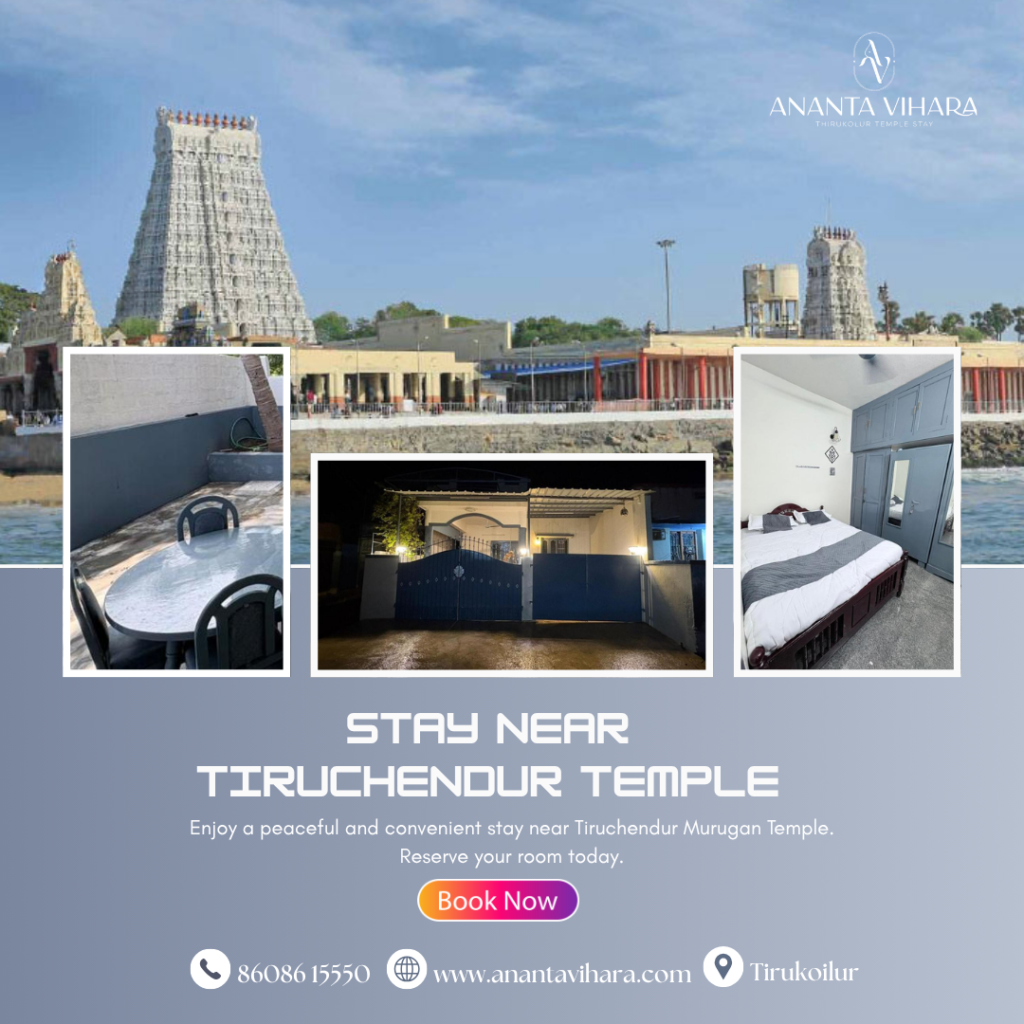
About the Temple & Deity
The Arulmigu Subramaniaswamy Temple is one of the six abodes Arupadaiveedu of Lord Murugan, where the Lord of Sound, Lord Senthilnathan, lives. Lord Muruga is the one who explained the meaning of the Pranava Manthiram OM to his father Lord Shiva.
The idol of Lord Murugan here is depicted as Senthil Andavar a youthful and valiant warrior. The temple’s Gopuram, or tower, is an architectural marvel standing at 137 feet tall.
The Rajagopuram rises 137 feet tall with 9 tiers. The sanctum sanctorum houses Lord Murugan along with Valli and Deivanai. Nazhikkinaru a freshwater spring near the seashore is considered sacred. The Shanmuga Vilasa Mandapam is a hall of artistic pillars. The Valli Cave Temple nearby is associated with Murugan’s divine marriage to Valli.
Extraordinary & Unique Facts
This is the only Hindu temple that has no Eastern gateway. This temple is the fourth Hindu temple in Tamil Nadu to receive ISO certification. This is the only temple in Tamil Nadu where the sanctum sanctorum is below ground level.
The most extraordinary fact about the temple is that even after being located so close to the sea, the temple has never been flooded a divine miracle witnessed over thousands of years.
The Tiruchendur temple has also been known by other names Tirucheer Alaivai, Senthil Jayanthi, Kanda Madana Parvatham, Veeravagu Pattinam, and Vyazha Kshethram. The name Vyazha Kshethram comes after the worship by Vyazha Bhagavan Jupiter God at this shrine.
The Dutch Miracle The Stolen Idol That Returned
Thiruchendur Murugan Temple is a very ancient temple. The temple endured Dutch occupancy in the 17th Century CE. The Dutch even took away the Utsava Murthy the procession deity as booty. When they encountered bad weather in the high seas, they threw the idol into the sea. The seas calmed and the idol was recovered by Vadamalaiyappa Pillai a few years later.
This extraordinary miracle where Lord Murugan’s idol caused storms at sea until it was returned stands as one of the most celebrated divine interventions in all of Tamil Nadu temple history.
Adi Shankaracharya's Healing
Sri Shankaracharya was once going through a phase of ill health due to evil acts of a rival. He visited Tiruchendur Murugan Temple as ordered by Lord Shiva. When he reached the Murugan temple sanctum, he saw a serpent worshipping the deity. Inspired by this devotion of the serpent, he created the Subrahmanya Bhujangam. He was also cured of his physical ailments at this sacred shrine.
Architecture A Marvel on the Seashore
The temple has been constructed in the Dravidian style and is spread over an area of about two acres. The nine-storey Mel Gopuram Raja Gopuram in the west rises to a height of 137 feet and was built in the 17th Century CE. The temple has three Prakarams. The main entrance faces south. Shanmukhavilas Mantap is in the entrance tower, consisting of 120 stone pillars.
Temple Open Hours: 5:00 AM – 12:30 PM & 5:00 PM – 9:00 PM
Major Festivals
Skanda Sashti (October–November) is the most significant festival with a dramatic re-enactment of Surasamharam. Vaikasi Visakam (May–June) celebrates Lord Murugan’s birthday. Thai Poosam (January–February) sees devotees carry kavadi as a penance.
Key festivals:
- Skanda Sashti & Soorasamharam — October–November (Most Grand — Millions attend)
- Vaikasi Visakam — May–June (Murugan’s Birthday)
- Thai Poosam — January–February (Kavadi festival)
- Panguni Uthiram — March–April (Sacred Thirukalyanam)
- Aadi Krithigai — July–August
- Karthigai Deepam — November–December
How to Reach
Nearest Railway Station: Tiruchendur Railway Station (2 km from temple) Nearest Airport: Thoothukudi Airport (~65 km) | Madurai Airport (~185 km) Bus Route: Direct buses from Tirunelveli, Thoothukudi, Madurai, Chennai & Nagercoil Best Time to Visit: October – March | Skanda Sashti (Oct–Nov) | Thai Poosam (Jan–Feb)
Most Recent Posts
- All Posts
- Nava Kailasam Temples
- Nava Tirupathi Temples
- Nearby Attractions
- Temples

Category
Tags
- Adhinatha Perumal Temple
- Agasthiyar Falls
- Agasthiyar Falls Papanasam
- Agasthyamalai Biosphere Reserve
- Alwarthirunagari
- Ananta Vihara Thirukolur
- Ancient Heritage Tamil Nadu
- Aravindalochanar Temple
- Arulmigu Subramaniya Swamy Temple
- Arupadai Veedu 2nd Temple
- Banatheertham Falls
- Bhoomipalagar Perumal
- Blackbuck Tamil Nadu
- Budha Sthalam Tirunelveli
- Budhan Sthalam
- Chandran Sthalam
- Chevvai Dosha Parihara
- Coastal Village Tamil Nadu
- Dakshina Gangai
- Devapiran Temple
- Divya Desam
- Gothaparameshwarar Temple
- Guru Sthalam
- Guru Sthalam Tirunelveli
- Holy Cross Church Manapad
- Homestay in Tirunelveli
- Homestay Near KMTR
- Homestay Near Kovilpatti
- Homestay Near Krishnapuram Temple
- Homestay Near Kutralam
- Homestay Near Manapad
- Homestay Near Nava Kailayam
- Homestay Near Nava Tirupati
- Homestay Near Papanasam
- Homestay Near Tiruchendur
- Homestay Near Vaithamanidhi Perumal Temple
- Homestay Near Wildlife Sanctuary
- Irattai Tirupathi
- Jupiter Temple Tamil Nadu
- Kaarkodaga Kshetram
- Kailasanathar Temple Kodaganallur
- Kailasanathar Temple Murappanadu
- Kailasanathar Temple Rajapathy
- Kailasanathar Temple Sernthapoomangalam
- Kailasanathar Temple Srivaikuntam
- Kailasanathar Temple Thenthiruperai
- Kalahasti Equivalent Tamil Nadu
- Kalakkad Mundanthurai Tiger Reserve
- Kalugumalai Jain Beds
- Kalugumalai Murugan Temple
- Kasinivendan Perumal
- Kazhugumalai Temple
- Keezh Kailayam Final Temple
- Keezh Kailayam First Temple
- Ketu Dosha Parihara
- Ketu Sthalam
- Ketu Sthalam Tirunelveli
- KMTR
- Kotha Parameswarar Temple Kunnathur
- Krishnapuram Temple Tirunelveli
- Krishnapuram Venkatachalapathy Temple
- Kuberasthalam
- Lord Vishnu Temple Tirunelveli
- Madhurakavi Alwar Birthplace
- Makara Nedunkuzhaikathar Temple
- Manapad Beach
- Manapad Thoothukudi
- Manimuthar Dam
- Manjolai Hills
- Mars Temple Tamil Nadu
- Mars Temple Tirunelveli
- Mayakoothar Perumal Temple
- Mercury Temple Tamil Nadu
- Mundanthurai Wildlife Safari
- Nadu Kailasam
- Naga Dosha Parihara
- Nammalvar Birthplace
- Natham Temple
- Nature Trek Tamil Nadu
- Nava Kailayam 3rd Temple
- Nava Kailayam 4th Temple
- Nava Kailayam 5th Temple
- Nava Kailayam 6th Temple
- Nava Kailayam 7th Temple
- Nava Kailayam 8th Temple
- Nava Kailayam 9th Temple
- Nava Kailayam First Temple
- Nava Kailayam Stay
- Nava Kailayam Tirunelveli
- Nava Tirupati 2nd Temple
- Nava Tirupati 4th Temple
- Nava Tirupati 7th Temple
- Nava Tirupati 8th Temple
- Nava Tirupati Divya Desam
- Nava Tirupati First Temple
- Nava Tirupati Homestay
- Nava Tirupati Nava Kailayam Srivaikuntam
- Nava Tirupati Nava Kailayam Thenthiruperai
- Nava Tirupati Yatra
- Nayak Architecture Temple
- Nigaril Mugil Vannan
- Pandya Rock Cut Temple
- Papanasa Nathar Temple
- Papanasam Dam
- Papanasam Temple
- Papanasam Tirunelveli
- Papanasanathar Temple
- Pilgrim Homestay TN
- Ponnammai Sametha Kailasanathar
- Rahu Sthalam
- Rahu Sthalam Tirunelveli
- Rettai Tirupathi North
- Rettai Tirupathi South
- River Bathing Thamirabarani
- Saendha Poomangalam Temple
- Sagittarius Pisces Temple
- Sangumugam
- Sani Sthalam Srivaikuntam
- Santhana Sababathi
- Saturn Temple Tamil Nadu
- Scorpio Aries Temple
- Senthil Andavar
- Serpent Planet Temple Tamil Nadu
- Sevvai Sthalam
- Shani Parihara Temple Tirunelveli
- Shani Sthalam
- Shukra Sthalam
- Skanda Sashti
- Snake Lingam Temple
- Soundaranayaki Sametha Kailasanathar
- South Tirupati Tamil Nadu
- Southernmost Blackbuck India
- Sri Srinivasa Perumal Temple
- Sri Srinivasa Perumal Temple Perungulam
- Srivaikuntam Temple
- Srivaikuntanathan Perumal Temple
- St Francis Xavier Manapad
- Stay Near Kazhugumalai
- Stay Near Papanasam
- Stay Near Tiruchendur
- Stay Near Tiruchendur Temple
- Stay Near Vallanadu Sanctuary
- Sukra Parihara Sthalam
- Surasamharam
- Surya Kailash
- Surya Kshetra
- Temple Stay Tamil Nadu
- Temple, Rettai Tirupathi North
- Temple, Rettai Tirupathi South
- Thamirabarani Seashore Temple
- Then Kalahasti
- Thenthiruperai
- Thirukolur Accommodation
- Thirukolur Temple
- Thirukurukur
- Thirunallaru Equivalent Tamil Nadu
- Thirupuliyangudi Perumal Temple,
- Thirutholaivillimangalam
- Thiruvaragunamangai
- Thoothukudi Nature Tourism
- Tiger Reserve Tirunelveli
- Tiruchendur Murugan Temple
- Vaikuntha Ekadashi Tirunelveli
- Vaithamanidhi Perumal Temple
- Vallanadu Blackbuck Sanctuary
- Vallanadu Wildlife Sanctuary
- Varuna Kshetram
- Venkatavanan Perumal
- Venus Temple Tamil Nadu
- Vettuvan Koil
- Vijayanagara Dynasty Temple
- Vijayasana Perumal Temple,
- Western Ghats Tamil Nadu
- Wildlife Sanctuary Tirunelveli