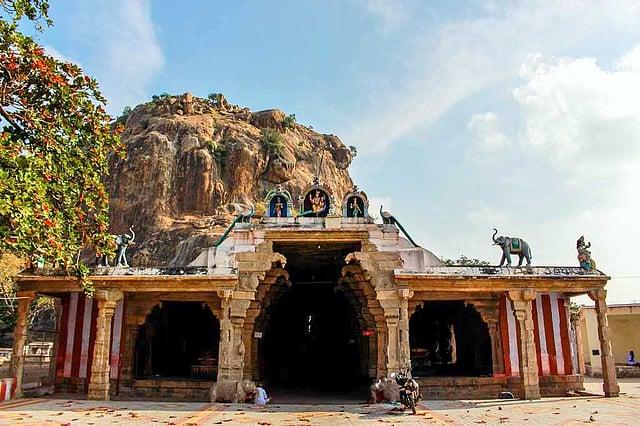
1. Arulmigu Kalugasalamoorthy Murugan Temple
Kalugasalamoorthy Temple or Kalugumalai Murugan Temple in Kalugumalai is dedicated to the Hindu god Murugan. Constructed in the Dravidian style of architecture, the core temple has rock-cut architecture exemplary of early Pandyan Art. The main deity hall and entrance hall are excavated inside the foothills of Kalugumalai in the south-western corner of the hill with external structural additions.
The Deity Three Rare Distinctions!
The sanctum faces West and the image of the presiding deity is 4 ft tall. The image is sported with six hands with one of them holding Vel the divine spear his left leg over the shoulder of the peacock and right is left hanging. There are separate shrines of his consorts Valli facing South and Deivanai facing North.
Kachiappar mentions that there are only three sacred temples of Murugan where he faces the South and this is the only temple where he faces south AND is also in a seated posture. Usually in Murugan temples, his vehicle peacock heads towards the right but it is sported to the left of Murugan here. It is believed that Indra, the king of celestial deities, appeared as a peacock to worship Murugan and hence the image of the peacock is covered during festivals.
The Legend of Jatayu & Sampati
Jatayu’s brother Sampati also called Kalugumahamunivar in local tradition was worried about not having performed the final rites for his brother. Rama advised him to perform penance at Gajamukaparvatham and take a holy dip in the tank. Later, when Murugan was pursuing Surapadman, Tarukasuran the brother of Surapadman was troubling the sages in the region. Murugan slew Tarukasuran and was resting at Kalugumalai. Sampati assisted Murugan and indicated the hideout of Surapadman, whom Murugan slew subsequently. Pleased with his devotion, Murugan offered him salvation. The place came to be known as Kalugumalai since the sage Kalugumahamunivar resided here.
2. Vettuvan Koil "A Sculptor's Paradise"
Situated near the Jain Beds, Vettuvan Koil is a Hindu temple built between the 8th and 9th centuries by Pandyan Maran Chadaiyan Varaguna I. About 7.5 metres of the mountain is excavated in a rectangular fashion, and in the middle, the temple is sculpted from a single piece of rock. The carvings reflect the southern temple style of the Pandiya era. Only the top portion of the temple is completed. At the top, beautiful sculptures of Uma Maheswarar, Dakshinamurthy, Vishnu, and Brahma can be found. This temple looks like the Kailasanatha Temple at Ellora.
Kalugumalai is a priceless unfinished Pandyan monolith cave temple part of the iconographic richness that helped chronicle the burgeoning richness of Tamil culture, traditions, and sacred centres containing religious art.
The Vettuvan Koil’s design incorporates Dravidian elements such as pillared halls and narrative friezes, showcasing advanced stone-working skills that rival contemporary Pallava influences but adapted to Pandyan aesthetics. Construction ceased prematurely possibly due to historical conflicts or royal shifts toward Shaivism.
 Fun Fact: Vettuvan Koil means “Temple of the Sculptor” a tribute to the extraordinary craftsmen who carved this entire temple out of a single living rock!
3. Kalugumalai Jain Beds — 150 Sacred Sculptures
The Kalugumalai Jain Beds are constructed in rock-cut architecture and are believed to have been built during the reign of Pandyan king Parantaka Nedunjadaiya (768–800 CE). The rock-cut architecture at Kalugumalai is an exemplary specimen of Pandyan art. There are approximately 150 niches in the bed that include images of Gomateshwara, Parshvanatha, and other Tirthankaras of Jainism.
There are 98 inscriptions related to Jainism at the Kalugumalai Jain Beds site the largest known concentration of Jain inscriptions in far South India at a single site. These are found below the reliefs of Tirthankaras and yakshis, as well as near the hollowed-out beds. Most are records of donors and gifts.
Kalugumalai is an important Jain site because it stands out as an exception where Digambara tradition women rose to prominence over its early history. Historic evidence of major groups of Digambara Jain women mendicants is rare except in Kalugumalai, where the local culture accepted and supported female monastic traditions for a few centuries after around the 9th century.
Protected Monument: The Jain Beds are maintained and administered by the Department of Archaeology of the Government of Tamil Nadu as a protected monument.
Why Kazhugumalai Is Extraordinary
The word Kalugumalai means “Vulture Peak” reminiscent of the legendary site in North India attributed to the Buddha for his sermons. Local traditions connect the history of this stone hillock with early but extinct Buddhism. Perhaps the hillock was once related to Buddhism, was abandoned, and later Jains and Hindus reused the site for their own monasteries and temples.
This makes Kazhugumalai one of the very few places in India where you can trace the footprints of four religious traditions Buddhism, Jainism, Shaivism, and Vaishnavism all on a single sacred hill spanning over 1,500 years of continuous spiritual history!
How to Reach
| From |
Distance |
Mode |
| Kovilpatti |
~22 km |
Bus / Taxi |
| Sankarankovil |
~21 km |
Bus / Taxi |
| Tirunelveli |
~53 km |
Bus / Taxi |
| Thoothukudi |
~88 km |
Bus / Taxi |
| Madurai |
~90 km |
Bus / Taxi |
| Ananta Vihara, Thirukolur |
~55 km |
Taxi / Own vehicle |
Nearest Railway Station: Kovilpatti Railway Station (~22 km) Bus Route: Buses from Tirunelveli, Kovilpatti & Madurai stop at Kalugumalai Best Time to Visit: October – March | Kanthasasti (Oct–Nov) | Thaipoosam (Jan–Feb)